


Maps of Today, Maps of Tomorrow
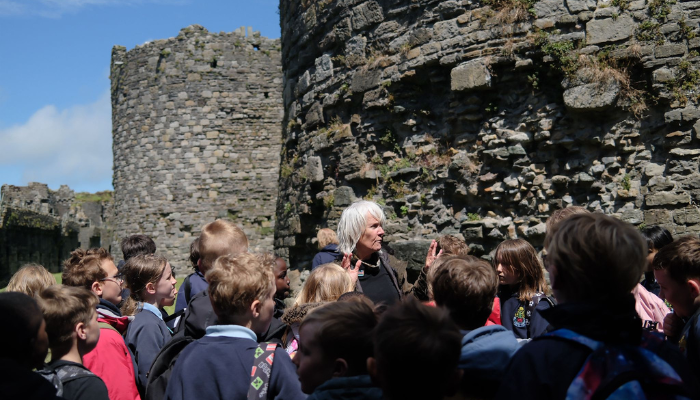
Maps of Today, Maps of Tomorrow is a major partnership between Cadw, Literature Wales and Children’s Laureate Wales, Nicola Davies. Together, we are delivering a new Wales-wide creative learning project that is set to inspire children to see their surroundings through fresh eyes. The project places heritage, creativity and children’s lived experience at the heart of learning, encouraging pupils to explore the past, present and future of the places they call home.
Mapping heritage, identity and imagination
Created by Nicola Davies, the project invites pupils to rethink what a map can be. Children will be supported to investigate the historic landscapes around them, discovering how castles, ancient sites, streets, fields and coastlines shape both community identity and personal memory. Drawing inspiration from sources as varied as prehistoric cave paintings, medieval maps and Polynesian star-path navigation, children will also explore mapping as a way of telling stories about place, identity and belonging, not simply as a technical or navigational exercise.
The project is closely linked to Nicola Davies’ new book, The Map of Me (2026), which tells the story of a child navigating a new city using a personalised map made by her mother. The narrative models the kind of creative mapping pupils will undertake: maps that include meaningful landmarks such as favourite trees, safe routes, meeting places and family homes, rather than conventional cartographic features alone.
From children’s ideas to living digital maps
A key creative strand of the project will see illustrator and artist Fran Evans working directly with the children’s ideas to create bespoke online maps for each participating school. Drawing on pupils’ drawings, writing, conversations and performances, Fran will translate their collective responses into richly layered digital maps that reflect each school’s unique sense of place.
These online maps will act both as creative outcomes and as shared digital spaces, allowing children to see their ideas valued, interpreted and brought together visually. The process introduces pupils to digital storytelling while reinforcing the message that maps can evolve, hold emotion, and represent many voices at once.
The project will culminate in a collective body of work, combining children’s maps, performances and digital outcomes, offering a powerful portrait of Wales as seen through young people’s eyes
Cadw’s role
Cadw’s partnership places Welsh heritage at the heart of the project, helping pupils understand how their own stories connect to the longer history of the land. Through engagement with Cadw sites, learning resources and local heritage narratives, children will explore how places change over time, and why they matter.
By linking creative mapping with heritage education, pupils will:
- Discover how landscapes are shaped by history and human activity
- Understand the cultural significance of local landmarks
- Explore how heritage knowledge can inform future thinking and care for place
This historical grounding gives depth and authenticity to the children’s creative work, encouraging them to see themselves as part of a continuing story.
With Cadw’s heritage expertise, Nicola Davies’ storytelling, and Fran Evans’ transformation of children’s ideas into living online maps, Maps of Today, Maps of Tomorrow promises to deepen pupils’ connection to their local environments while empowering them to imagine the landscapes of the future.
With thanks to the Ashley Foundation.
Additional Information
How the Project Supports the Curriculum for Wales
Maps of Today, Maps of Tomorrow aligns closely with the ambitions of the new Curriculum for Wales, offering a rich, cross-disciplinary learning experience.
Developing ambitious, capable learners
Through researching their local area and heritage, pupils will strengthen information-handling, critical thinking and observational skills, learning to ask questions, interpret evidence and work with increasing independence.
Enhancing visual and spatial literacy
By analysing historical and contemporary maps and creating their own, both physical and digital, children will deepen their understanding of how places can be represented. Their work will feed into a larger collaborative map, bringing together creative responses from schools across Wales.
Building awareness of climate change and future resilience
With Cadw’s conservation perspective informing discussion, pupils will explore how climate change affects both natural environments and historic sites, and consider how communities can respond creatively and responsibly.
Developing expressive and collaborative skills
Some groups may choose to respond through performance, poetry, song, spoken word or protest pieces, strengthening oracy, teamwork and confidence while giving voice to their ideas about place and identity.