

Iola Ynyr is a writer and creative facilitator. In 2025 she won the Wales Book of the Year Award for her memoir, Camu (Y Lolfa). This case study is an interview with her from February 2026. We wanted to discover more about her work, and how working with people and communities influences her creative practice, and vice versa. Read on to find out more!
Tell us a little about yourself and your work
I’m an author who also facilitates creative workshops to encourage individuals and communities to promote their well-being through writing and imagination. My intention is to create a safe space to discuss and develop ideas without shame, encouraging a mindset where we can imagine a caring world for ourselves and others.
My writing explores how we can present a narrative that inspires individuals to trust their intuition and to reflect on the beauty and wonder of the world even in challenging and dark times.
When did your interest in creative writing begin?
I have enjoyed creative writing and using my imagination since I was a child, but it’s taken me until my fifties, and my recovery from alcoholism, to trust that I have something worth saying and to share my writing publicly and openly.
I have kept a diary religiously all my life, and have played with different ideas since my teenage years, but attending courses at Tŷ Newydd provided the motivation to shape and formalise these ideas.
Reading has always inspired me and has sustained me, therefore, with the publication of my memoir in 2024, it was a privilege to be able to provide a modest contribution to our literary culture, and for that contribution to be in the Welsh language.
I’m convinced that there are so many more writers with valuable stories to share, but who are on the margins of society and don’t have the confidence to share them. Trying to discover these individuals and equip them with the faith they need to read their work or discuss their ideas aloud is central to my work as a creative facilitator.
Can you discuss the relationship between writing creatively and being a creative facilitator? Do they inform and enrich each other? Did one lead to the other?
Delivering creative sessions as a facilitator, especially with vulnerable participants reminds me of the bravery required to express our ideas on paper. I am inspired by resilience and an individual’s willingness to venture despite their uncertainty, and in turn I am myself encouraged, and itching to have a go at playing with my own ideas.
There’s nothing better than listening to other people’s experiences and their reactions to the world to stimulate me to consider my own.
For me, any session I facilitate is an opportunity to play and lose myself in the moment, exactly as children do, and is a priceless tool for feeling better about myself, my creativity and my connection to the world. Whilst ensuring that I look after the well-being of the participants, I am also gaining creative nourishment myself.
Since I won the Wales Book of the Year Award 2025, I have received more opportunities to use my own creative work as a stimulus for creativity in others. This is a new way of working for me, and although it’s slightly alien, it often allows participants to venture into areas of vulnerability in themselves, and to release ideas which have been suppressed for some time.
Delivering participatory work with care and safely is more important to me than ever, and I am now at a point where I have mastered the practice of checking in and reflecting on my own well-being consistently throughout the process.
The participatory work came first and most naturally for me. But it was the voices of the participants and their ability to tell their stories that spurred me on to share my own work.
I also enjoy attending creative sessions as a participant, and understand the huge benefits from being supported in a creative and safe environment.
When did you start thinking about yourself as a “writer”?
I called myself a writer for the first time when I was getting my nails done before heading over to the Wales Book of the Year Awards Ceremony.
I have written a chapter about this in my new book Codi Hwyliau, which will be published this summer. [2026] The woman treating my nails was sharing her journey from Vietnam to Wales to follow her dreams of releasing herself from the social pressures her community had placed on her to care for her husband’s family, and her desire to see more of the world. Hearing her story made me think how I would like to be ‘seen’ by others. This was a turning point for me, and proof that I am taking my writing seriously.
Looking back, that moment might have been more significant than winning the award itself, even though that was incredibly wonderful too!
How did you come to know about Literature Wales and the support they offer writers?
I attended a course at Tŷ Newydd 25 years ago, and through that came to know Literature Wales. I still consider the organisation as the first experience writers have of a sanctuary that allow them to thrive, with supportive and enthusiastic staff members.
Since that first visit, I have returned to attend many courses and have received support to develop my practice as a creative facilitator and writer.
Can you give an overview of how you’ve worked with Literature Wales, and how that work has influenced your work and your career?
I have received training as a facilitator, have trained and mentored others, and have developed and delivered activities through various programmes. ‘Ar y Dibyn’, a Welsh-language creative project for those affected by dependence, was made possible through the Literature for Well-being Funding Scheme seven years ago, and none of its success would have been possible were it not for that call-out for ideas as an initial incentive.
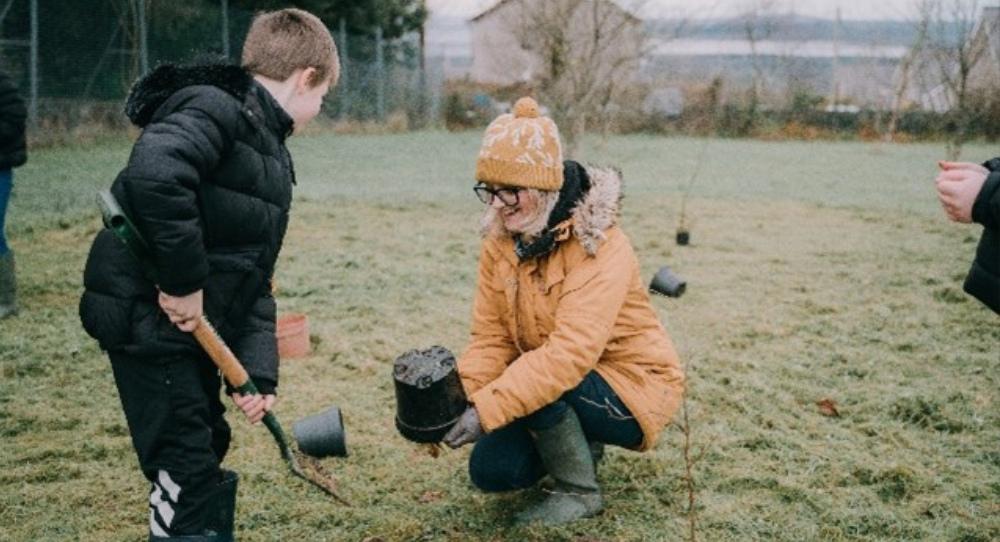
From 2022-2024, I ran the Gwledda project alongside WWF and North Wales Wildlife Trust in partnership with the school at Rhosgadfan, GwyrddNi and Cae’r Gors Community Centre. The project drew literary inspiration from working in the school’s vegetable garden and the works of Kate Roberts, to planting trees in the school grounds. Later, we used Kate Roberts’ cloak as a stimulus to explore our connection to the land, which led to creating a wooden statue of the cloak at Cae’r Gors which had the community’s words engraved into it.
Mentoring was a golden opportunity for me to reflect on how to create safe spaces in a practical sense rather than verbally only. It was an absolute pleasure. I think I have benefitted more than those who were being mentored, who are writers I greatly admire such as Casia Wiliam, Meleri Prysor, Grug Muse and Elinor Wyn Reynolds.
I led a training weekend at Tŷ Newydd alongside clare potter. It was an honour, especially to encourage and nurture the participants’ confidence to use poetry and prose to share their true vision of the world.
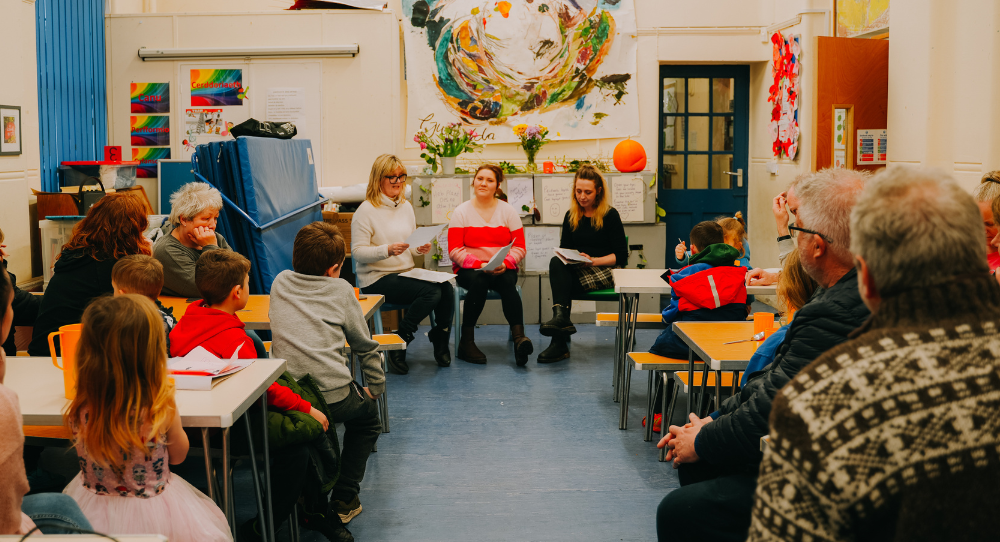
Most recently, I got to meet a group of brave and talented women on a day course to share our stories based on my book, Camu. I am confident that many books will soon see the light of day, inspired by the ideas we shared that day, and I am so appreciative of the opportunity to encourage others on that path.
When I consider Literature Wales and its vision, the mindset I have is one of caring support, perseverance and the bravery to document, through literature, the pleasure and anguish that life brings us. They don’t offer an ‘easy-fix’, but they offer the faith that realizing the desire to write is worthwhile, and that we all have the right to imagine the map that will lead us through that process with their support.
Are there any projects or specific works that have been directly impacted by the support Literature Wales has given you?
The training on safeguarding that I received from Literature Wales has always reminded me to remember the power literature of all kinds can have to shatter inequality, discrimination and pain, and to take it seriously as a balm which can enrich every aspect of our lives.
I have had the opportunity to sit on selection panels for programmes such as Representing Wales and Writing Well which has introduced me to amazing writers, both established and up-and-coming.
Every staff member I’ve had contact with at the organisation has been completely dedicated, caring and have convinced me to imagine more for myself as a creative facilitator and writer. When I have faced challenges, especially surrounding sensitive matters and safeguarding, there is always wise and professional guidance available whilst also allowing for the development of important literary and community work.
In what way, if at all, has Literature Wales helped you develop your career or visibility as a writer?
Through the support of staff at Literature Wales and funding I have received from the organisation, I have been able to step out of my role as a creative facilitator into the role of a writer, and have been able to do so in a quiet, careful way with plenty of encouragement.
I have been shown a golden path, almost without realising it, to fulfilling my ambitions as a writer.
Winning the Wales Book of the Year Award has opened up new networks for me. Especially with literary festivals, reading and writing groups, but also publishers, bookshops and readers themselves.
When it comes my work as a creative facilitator, I’ve been able to nurture relationships with prominent organisations in fields regarding the climate emergency and environmental matters. This ability to collaborate and share good practice is key to the process of personal growth, within the creative community and at grassroots level.
Recently, I was invited to contribute to the Chronic Women / Menywod Cronig poetry anthology, a project led by Hanan Issa and Gwyneth Lewis, and I would never have dreamt that I would have a poem published alongside some of the most prominent poets in Wales. It was a completely unexpected opportunity, but this, for me, is Literature Wales’ strength; they gently and slowly guide and support writers which makes the process of venturing into unknown territory feel safe and natural.
How do you think your relationship with Literature Wales might evolve in the future?
would love to contribute in any way I can towards inspiring new, brave work both in the community and on the page, particularly with women in the Welsh language. There are still so many taboos related to the experiences of being a woman that haven’t been voiced freely.
The weight of being a woman who ‘sustains’ the Welsh language is also interesting to me, and the way the language can demand more attention than our own personal well-being.
I’m also passionate about facilitating and helping individuals and communities on the margins of society to express themselves and share experiences which are often difficult to hear. The idea of ‘shame’ is one that interests me, and how we can authentically respond to the societal and cultural influence which has stopped us from expressing our true experiences.
I have faith that we can, with tenderness, reflect on the beauty that stems from life’s challenges through all kinds of literature and creative activities.
We need stories and literature that can quietly inspire us to know that growth and faith derive from connections not differences. To remember our deep desire to belong to the creative power of love which resides somewhere in the heart of every cynic who has had to harden and become embittered to try and protect themselves, and that there is fellowship in creativity.