


BLOG: But There Is Me – Gillian Brownson
The Start of It
Back in March 2025, Literature Wales asked a simple question in one of their many callouts supporting Welsh writers:
“Do you believe in the power of literature and nature to inspire, improve, and brighten lives?”
I knew the answer was yes.
My writing journey started in my attic bedroom, a space shared with my sister, Bros and Michael Jackson posters, dirty clothes, and plates. Sorry, Mam! I had been writing a daily diary for two years by then. It was full of dreams and thoughts about my friendships.
Then, at 14, I discovered the work of Dylan Thomas in my English lessons at school, and I wrote my first poem.
Between poems and plays, I was on my bike, exploring Penrhos Woods and Porthdafarch Beach with my friends.
Through the following years, as a teenager navigating bullies and the complications of high school life in Holyhead, and later as an adult holding the roles of daughter, wife, and mum, literature, stories, and nature have grounded me.
Whenever life feels hectic or stressful, I return to the page, a walk, or a sea swim to steady my mind. Words and wild spaces have given me comfort, calm, and often, strength.
In my professional life as a writer, storyteller, and theatre practitioner, I’ve delivered hundreds of workshops, supporting people from all walks of life in developing their writing or performance skills. I’ve spent many happy hours teaching character development, pacing, and plot. I always hoped these sessions might boost the confidence of a catch-up reader in North Wales, or shift the direction of a young person at risk in London. But I had never truly considered the importance of creative writing as a vehicle to simply feel well.
Writing Well
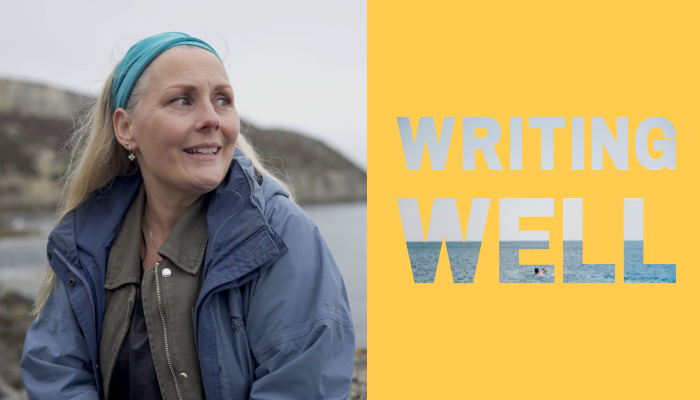
The Writing Well programme at Literature Wales invites writers and the community to explore exactly that: writing as a gentle, relational experience, often rooted in connection and wellbeing rather than in craft or outcome.
The callout came at the perfect time. I was working with the Arts Council of Wales on reforms to make the curriculum more inclusive and meaningful for both children and teachers, which encouraged me to think more deeply about how the Expressive Arts can support young people’s social and emotional literacy. At the same time, I was the Additional Learning Needs link governor at a primary school in Holyhead and serving as a Contemporary Bard for Cambridge University. Through those roles combined, I was awarded a funded place on a Level 5 Diploma in Trauma-Informed Schools & Communities — training that aligned meaningfully with my work with Anglesey children.
When I completed the diploma, I immediately began applying its ideas in my Bardic work, making poetry and stories with children. But that work was geared toward collecting creative data for the University’s research. Literature Wales’s callout offered something different: a chance to work solely for a child’s wellbeing.
I applied straight away.
Creative Friends
I was elated to be selected as part of a cohort of six writers, each doing inspiring work in their field. We gathered at the National Writing Centre of Wales for a retreat led by poet Clare Potter and poetry therapist Jay Teague, who encouraged us to draw on Tŷ Newydd’s beautiful surroundings to explore our creative responses to nature.
The writing that emerged was funny, sometimes sad, tender, and life-affirming. We discovered that writing for our own wellness not only enriches the moment but helps us make sense of life’s many complications.
Alongside this, we received invaluable online training and a toolbox of creative writing resources. We were each assigned a creative friend too — a working writer who would accompany us throughout the process. Mine was Eloise Williams, whose sensitive online workshops during her time as the inaugural Children’s Laureate for Wales supported my daughters and me through the pandemic. Her writing approach, using nature as inspiration, was exactly the sort of method I hoped to emulate on the Writing Well programme.
After discussing my ideas with Eloise, meeting with the local secondary school, and ensuring all safeguarding was in place, it was finally time to meet my small group of bold Young Writers. These were young people between the ages of twelve and fifteen, who were all accessing various interventions at school. Across seven weeks, with no set outcomes beyond hope, we aimed to discover what creative writing might offer us.
I was nervous — even after years of working with large class sizes, this time, it was just three or four of us, with no formal lesson plan, just a few gentle writing exercises, a shared space and a shared intention.
Finding Words and Finding Ways
“Pop, Curly, Colourful, Bright…
Reminds me of my dreams.”
— By Ieat Moths, inspired by a pair of dress-up glasses
We began by writing from found objects in nature: shells, pine cones, pebbles, and seaglass. But the group quickly shifted to objects from natural objects to objects that were meaningful to them — an old dog collar, a black candle, funky dress-up glasses, even a single discarded ring pull.
Together, we explored how these items might lead us into stories and poems. Slowly, their inspirations took shape:
“But there is me, a ring pull,
Who is stuck here,
However, not for much longer…”
— By Lily Pudge
Over the weeks, we chatted, shared chocolate treats, and followed the threads of their ideas. Their writing touched on loss, conflict, belonging, and friendship — but always through the lens of their characters, and always in a safe and gentle space.
Their rich scribbles turned into creations which ranged from high fantasy to poetic journaling, all of which became a pamphlet shared with the school and Literature Wales.
“A tale of fate begins to unfold as two twins’ fates are sealed in the stars…”
— By Bran Azure, inspired by a black candle
Creative Reflections — A Room With a View
A pivotal moment in my development came from a Creative Evaluation session led by Therapeutic Writing Facilitator Jane Willis. In community arts work, evaluation often relies on forms and questionnaires. Through these, participants may offer glimpses into their experience, somewhere between their ‘date of birth’ and ‘would you do this activity again?’, but they rarely offer a true reflection of the creative experience.
Jane introduced collage and found objects as a way for participants to choose symbols representing their experience — a method which reminded me of my trauma-informed training, where we explored metaphor as a safe doorway into reflection.
So, in our final session, instead of feedback forms, I invited the Young Writers to create a symbolic room inside a small matchbox — a tiny space representing their writing journey.
We chose wallpaper colours, a landscape through the window, a chair, and a little pet. As we crafted, we talked. And through these conversations, each detail gained meaning. Was their pet nervous? Curious? Shy? Was their landscape sunny, rainy or cold?
One young person added a sloth because he looked sad — they explained they were sad to be finishing. Their warm wallpaper represented the calm they felt in our little library haven, so different from the everyday loudness of school.
Each matchbox room held its own quiet story. Each offered new insight into the impact of our time together. And each became a small keepsake from a meaningful seven weeks.
The End of It
The last session was four months ago. Since then, I’ve used many of the Writing Well approaches in a Writing for Wellbeing series with the RSPB, and in a Writing Memories workshop for The Conwy Fringe.
Now I’m sitting back in my Mam’s attic in Holyhead — my writing place. I moved out more than 25 years ago, but she lets me use it as my own house is too busy. It was my teenage bedroom, the place where I first learned that writing could hold me steady. I wrote Attic Girl here, a poem that will likely never be published, but one that captured how Dylan Thomas’ words helped a fourteen-year-old girl to find purpose.
The view is the same: Holyhead rooftops, seagulls circling Skinner’s Monument. It is quiet. Calm. And the need for this space — this pause — is the same need one of the Young Writers described in their matchbox room.
Writing Well has brought me full circle.
Do I believe in the power of literature to inspire, improve, and brighten lives?
Yes. I always did.
But now I know something more:
Writing for and with children and young people is what will shape the next phase of my career.
Thank you, Literature Wales.